
Skip to content

IBIS · clinical knowledge

IBIS, knowledge that supports and guides

Medical knowledge beside the record.

IBIS brings medical knowledge to the case in front of you: advisory differential suggestions and ICD-10 coding support, beside the patient's record. AI suggests; clinicians decide.
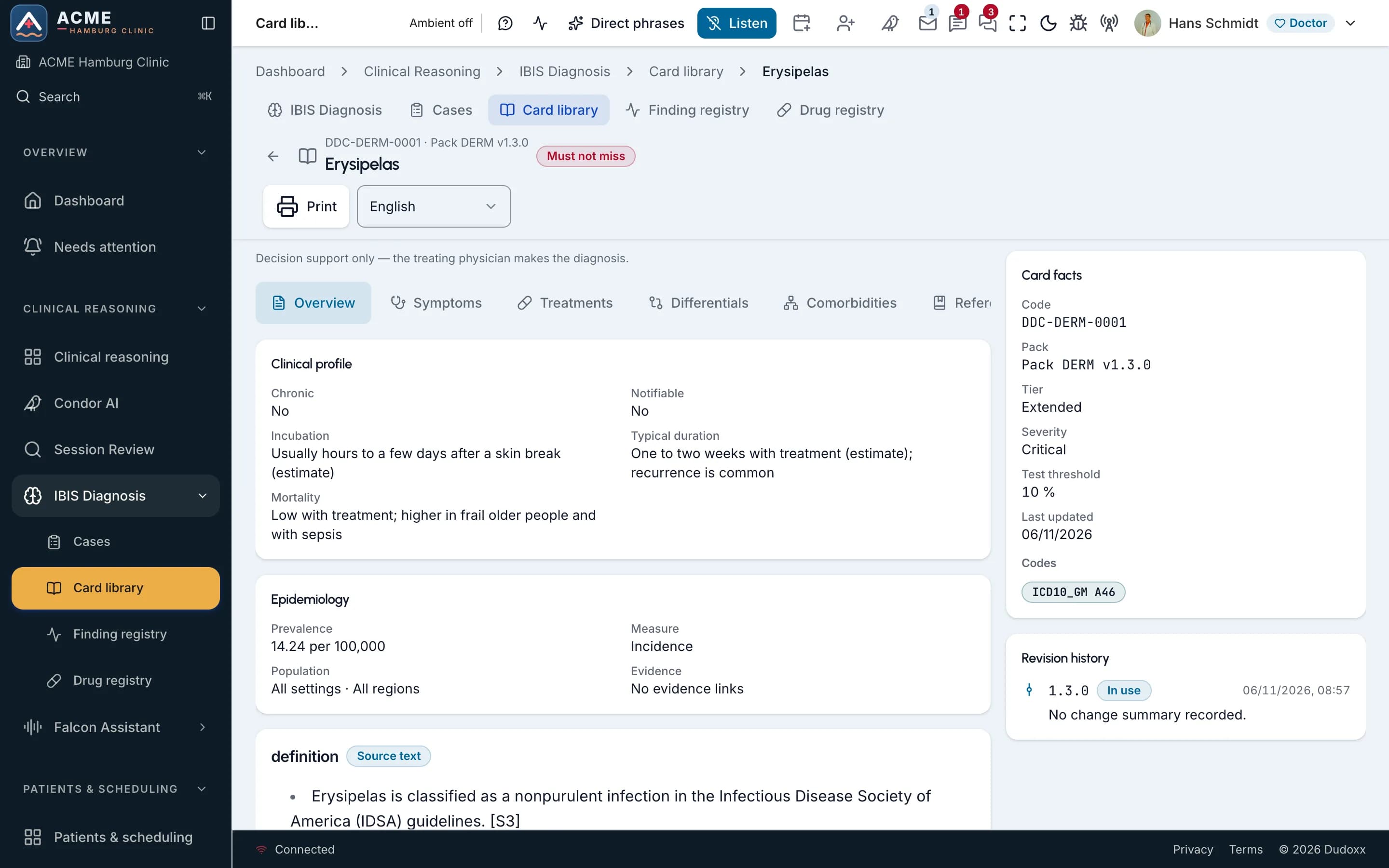
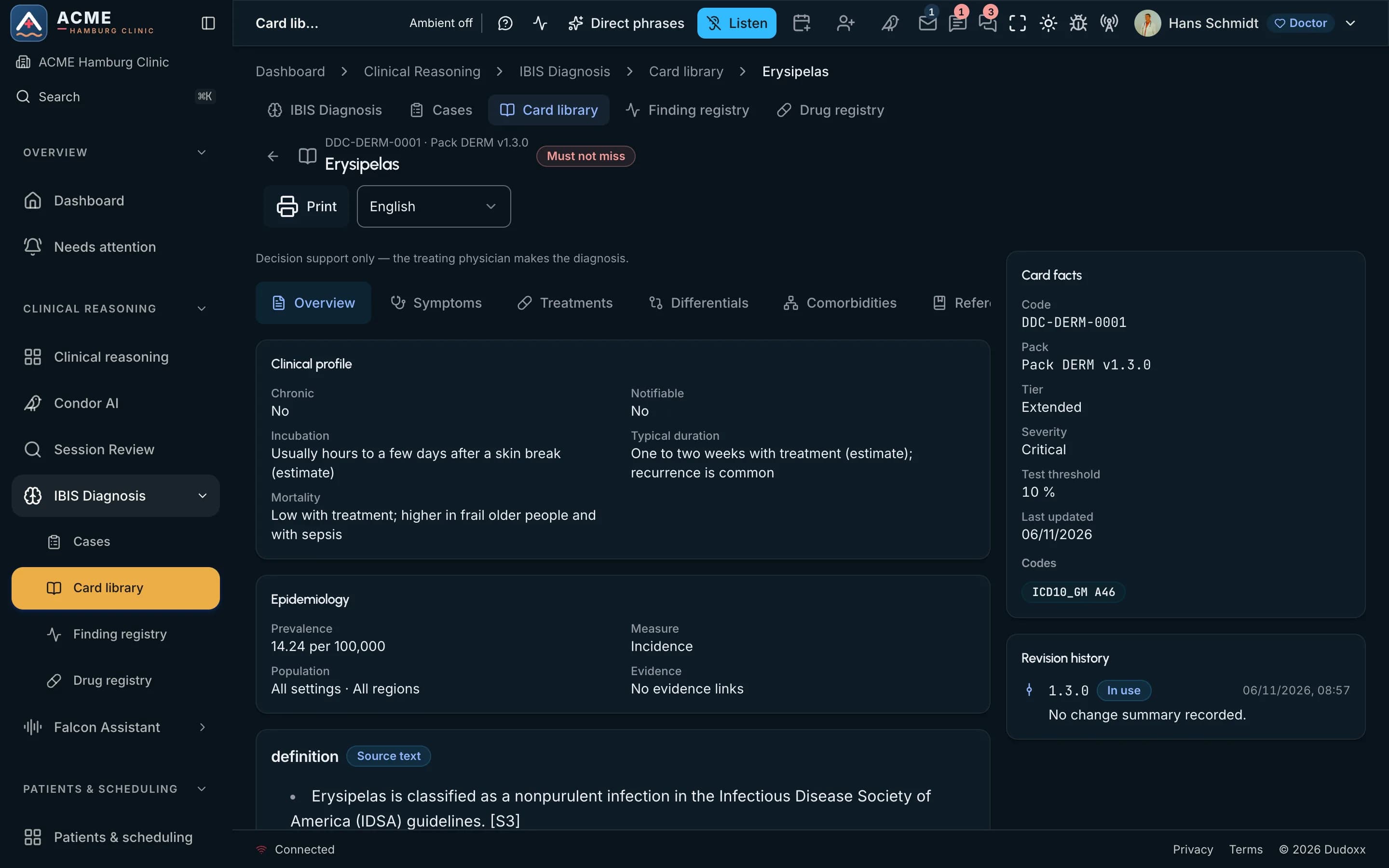
An IBIS disease card in a demo clinic: the clinical profile, the card facts and the revision history.An IBIS disease card in a demo clinic: the clinical profile, the card facts and the revision history.

On the screen

  1. Whole screen
  2. Zoom in
  3. Move across
Real screenAn IBIS disease card in a demo clinic: the clinical profile, the card facts and the revision history.

What IBIS brings

  • Symptoms to suggestions

    From symptoms, findings and history, IBIS suggests conditions worth considering, for the doctor's review.

  • ICD-10 at hand

    ICD-10 coding support sits where the diagnosis is entered, close to the knowledge behind it.

  • The clinician decides

    IBIS suggests what to consider; the clinician examines, asks, weighs and concludes.

Watch how it works

A narrated tour of the real screens, chapter by chapter.

The IBIS diagnosis engine

What we built and what it can't do yet: the architecture, the data flows, the screens per role and the path to production.
Narrated in: English, German37 chapters

All manuals

IBIS at work

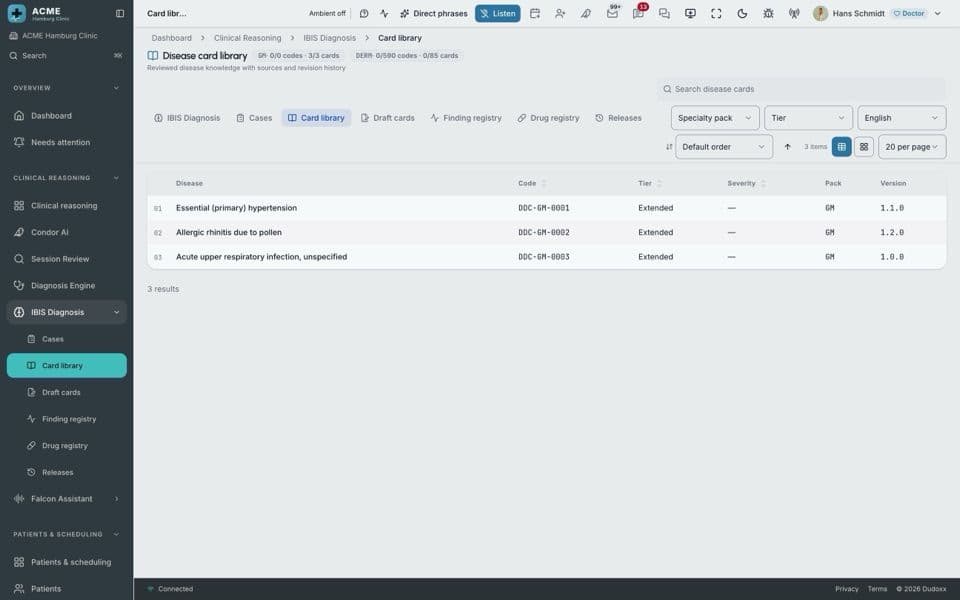
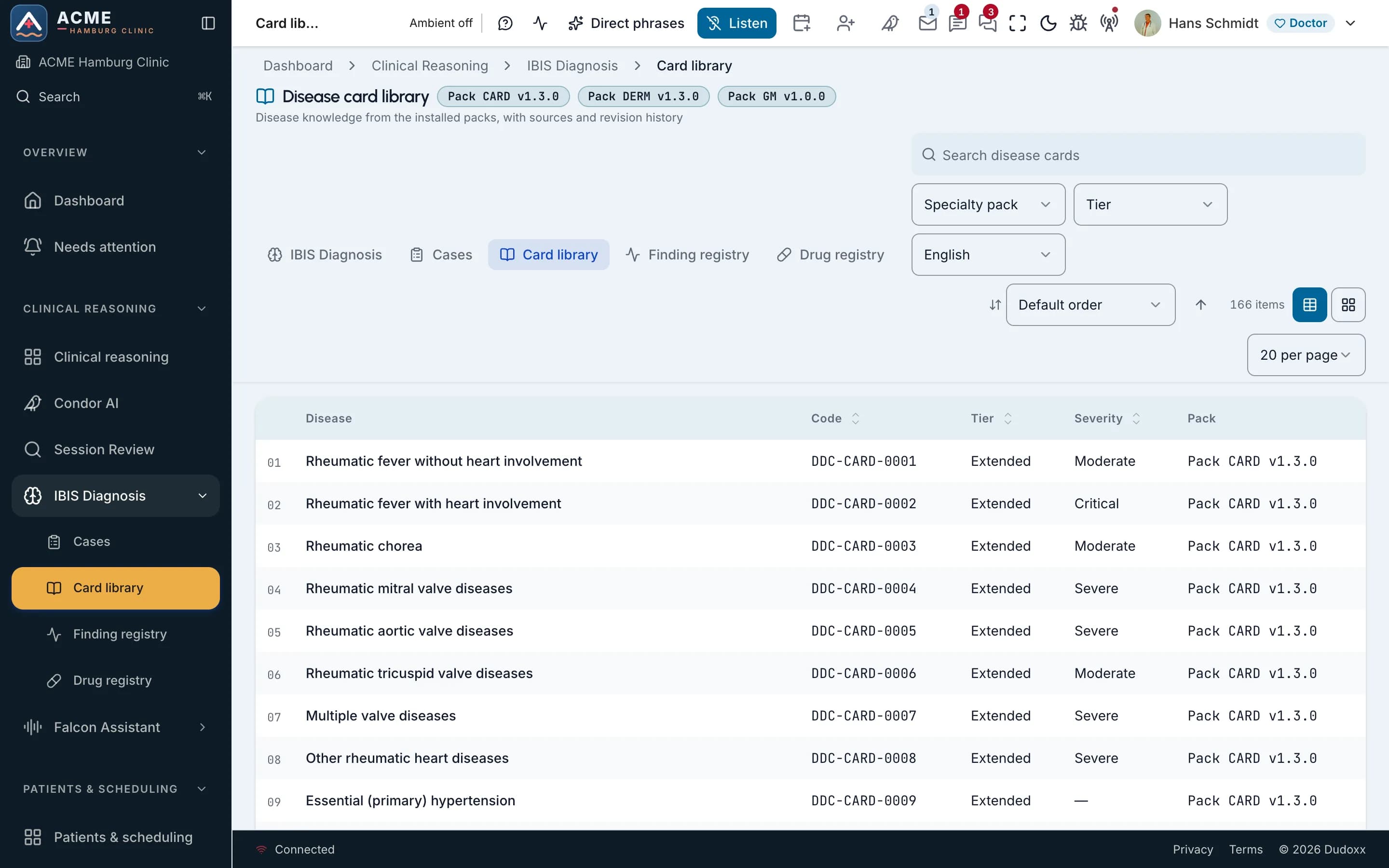
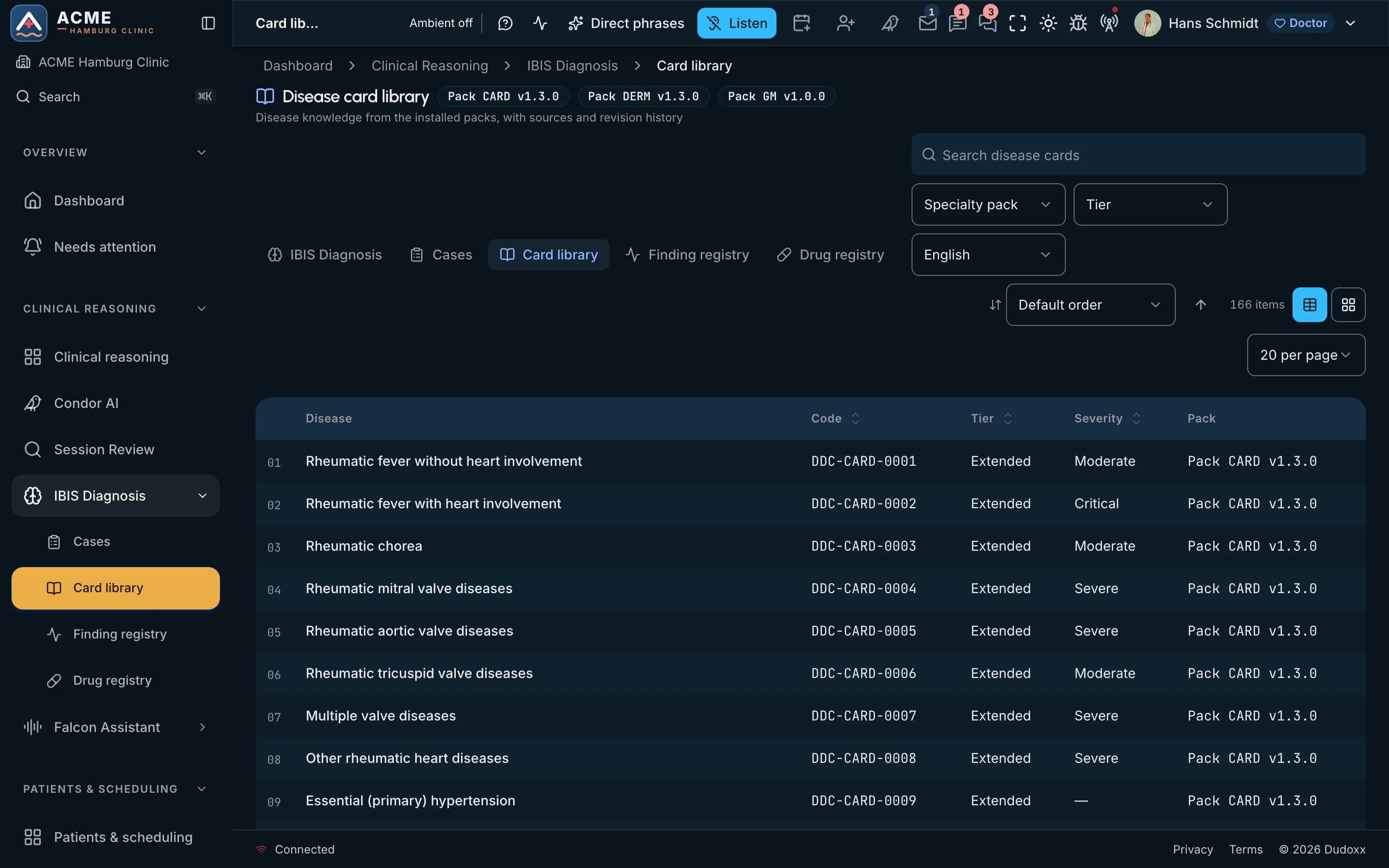
  1. The IBIS disease card library of a demo clinic: each card with its code, tier, severity and pack.The IBIS disease card library of a demo clinic: each card with its code, tier, severity and pack.

    On the screen

    1. Whole screen
    2. Zoom in
    3. Move across
    Real screenThe IBIS disease card library of a demo clinic: each card with its code, tier, severity and pack.

    Curated knowledge base

    The knowledge is organised around disease entities: what a condition looks like and what it is confused with.

  2. An IBIS disease card in a demo clinic: the clinical profile, the card facts and the revision history.An IBIS disease card in a demo clinic: the clinical profile, the card facts and the revision history.

    On the screen

    1. Whole screen
    2. Zoom in
    3. Move across
    Real screenAn IBIS disease card in a demo clinic: the clinical profile, the card facts and the revision history.

    Supports and guides

    IBIS brings clinical knowledge to the case: knowledge that supports care and guides with suggestions.

How IBIS guides a case

IBIS: rules rank the differential, the model explains, the doctor decides Findings from the visit, present and absent, are coded and scored against one set of versioned, read-only knowledge packs (AI-written, labelled unreviewed). The ranking, red flags and drug-safety checks come from fixed rules: the same findings give the same result. IBIS then explains the ranked list with card sources and never ranks or scores. Uploaded or older findings are held until the doctor confirms them; an open next-best question is answered by the doctor (or marked unknown) and the case is scored again. The doctor records the decision, and only a confirmed diagnosis is written to the patient record. Nothing reaches the patient. ranked list with sources doctor confirms open question answered, scored again confirmed Held findings uploads, older notes wait for the doctor Next best question the doctor answers, or says unknown Patient record diagnosis written only after the confirm Findings present and absent signs 1 Knowledge packs versioned · read-only AI-written, unreviewed 2 Scored by rules same findings, same result red flags · drug safety 3 IBIS Explained cites the cards never ranks or scores 4 Doctor decides records the decision 5 Nothing IBIS shows reaches the patient. Pack content is AI-written and labelled unreviewed: a clinician reviews a card before clinical use. decided by rules / written doctor checkpoint starts here curated knowledge automatic step doctor decides
IBIS: rules rank the differential, the model explains, the doctor decides Findings from the visit, present and absent, are coded and scored against one set of versioned, read-only knowledge packs (AI-written, labelled unreviewed). The ranking, red flags and drug-safety checks come from fixed rules: the same findings give the same result. IBIS then explains the ranked list with card sources and never ranks or scores. Uploaded or older findings are held until the doctor confirms them; an open next-best question is answered by the doctor (or marked unknown) and the case is scored again. The doctor records the decision, and only a confirmed diagnosis is written to the patient record. Nothing reaches the patient. doctor confirms coded terms one pack set open question answered, scored again ranked list with sources confirmed Findings present and absent signs 1 Held findings uploads, older notes wait for the doctor Knowledge packs versioned · read-only AI-written, unreviewed 2 Scored by rules same findings, same result red flags · drug safety 3 Next best question the doctor answers, or says unknown IBIS Explained cites the cards never ranks or scores 4 Doctor decides records the decision 5 Patient record diagnosis written only after the confirm Nothing IBIS shows reaches the patient. Pack content is AI-written and labelled unreviewed: a clinician reviews a card before clinical use. decided by rules / written doctor checkpoint starts here curated knowledge automatic step doctor decides

IBIS diagnosis support in five steps: findings, knowledge packs, scoring by fixed rules, an explanation with sources, and the doctor’s decision.

Open the full diagram (opens in a new tab)

What doctors ask about IBIS

Bring a hard case to the demo

We will show you what IBIS suggests and how you decide.